

Chinese Medicine is a complex medical system that has evolved over many centuries. Rather than focusing on isolated symptoms, it is based on understanding functional relationships within the body. Every treatment is grounded in an individual Chinese medical diagnosis, from which appropriate therapeutic methods are derived.
Among the core treatment methods of Chinese Medicine are acupuncture, Chinese pharmacology, and Tuina. Depending on the diagnosis and the individual situation, these methods may be used on their own or in combination, always with the aim of supporting the body’s natural regulatory capacity.
Acupuncture
Acupuncture is the best-known treatment method of Chinese Medicine in the Western world. It is used to apply regulating, moving, or balancing impulses within the body. Its theoretical foundation is the meridian system – a network of pathways that connects the internal organs with the musculoskeletal system.
From a Chinese medical perspective, functional imbalances are reflected along the course of these meridians. Through the targeted selection and combination of acupuncture points, specific processes can be influenced and harmonised. These points are not necessarily located where symptoms are perceived, but where regulation is considered effective according to Chinese medical principles.
Acupuncture needles are very thin and flexible and have a rounded tip. They find their way through the tissue gently. How acupuncture is experienced varies from person to person: some feel almost nothing, while others notice a brief prick, tingling, or a mild sensation of pressure. Many people describe the overall experience as calming and relaxing.
The needles usually remain in place for around 20 to 30 minutes. The impulse of the acupuncture points holds on for a while after the needles are removed, which is why it can be helpful to take the rest of the day at a slightly slower pace. In certain patterns, acupuncture may be complemented by moxibustion to gently warm and activate specific points or body regions.
Chinese Herbal Medicine
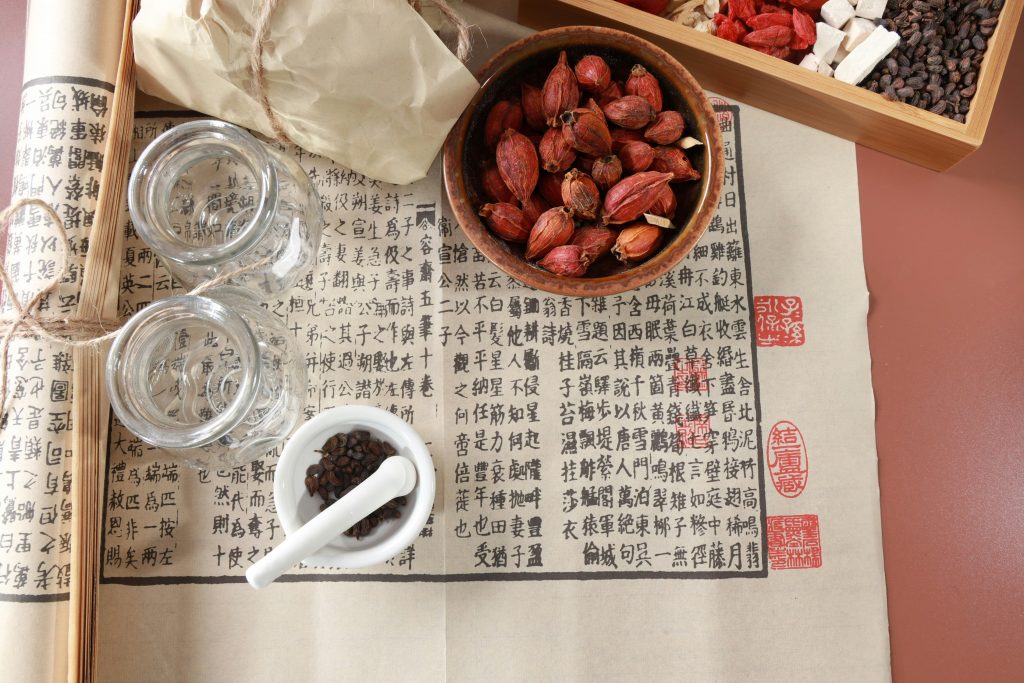
Chinese herbal medicine may be less widely known in Western countries, however it is the most extensive and central branch of Chinese Medicine. It is often referred to as Chinese ‘herbal’ medicine, although this term is somewhat misleading. While most ingredients are plant-based substances, Chinese herbal medicine also includes mineral and animal-derived components.
The selection of medicinal substances is always based on the individual Chinese medical diagnosis. Chinese herbal formulas are used in particular when deeper or more complex patterns are present. The individual ingredients in a formula are combined according to their Chinese medical properties.
Traditionally, the ingredients are cooked over an extended period to produce a concentrated decoction. As an alternative, granules are available – pre-cooked and dried extracts in powder form that are dissolved in hot water. Granules can also be pressed into tablets or filled into capsules.
Which form of preparation and which therapeutic approach is most appropriate is determined by the diagnosis and discussed on an individual basis.
Tuina Massage – Li Style
Tuina encompasses the manual treatment techniques of Chinese Medicine. These include classical massage techniques such as circular movements and pressure on tense muscles, as well as Gua Sha (scraping techniques applied to the skin), cupping, and techniques using massage tools, towels, or silk cloths. External herbal ointments are also commonly used.
Tuina is often applied alongside acupuncture and/or Chinese herbal medicine, particularly in cases of functional restrictions of the musculoskeletal system or blockages within the meridian system. Depending on the therapeutic aim, techniques may be very gentle or applied with greater pressure.
As with all branches of Chinese medicine, the most important aspect in Tuina is its holistic approach. The body is viewed as an interconnected whole, and areas of discomfort are not considered in isolation. This understanding is informed by the principles of T’ai Chi, which teaches how the body moves in harmony, allowing new movement patterns to develop and supporting the free flow of energy. In Tuina, this understanding of movement is applied to encourage natural and functional patterns in others.
The Li style is a very comprehensive and detailed family tradition, encompassing not only Tuina but also T’ai Chi, Qi Gong (K’ai Men and Dao Yin exercises), and martial arts (Feng Shou, Chi Shu, and Shuai Jiao). The Taoist Arts Organisation has been teaching the full scope of the Li Style since 1995 – you can read more about it on the TAO Website.

Individual Approaches
Acupuncture, Chinese herbal medicine, and Tuina are very often used in combination. Which method or combination is appropriate in an individual case depends on the underlying pattern, the current condition, and personal circumstances.

