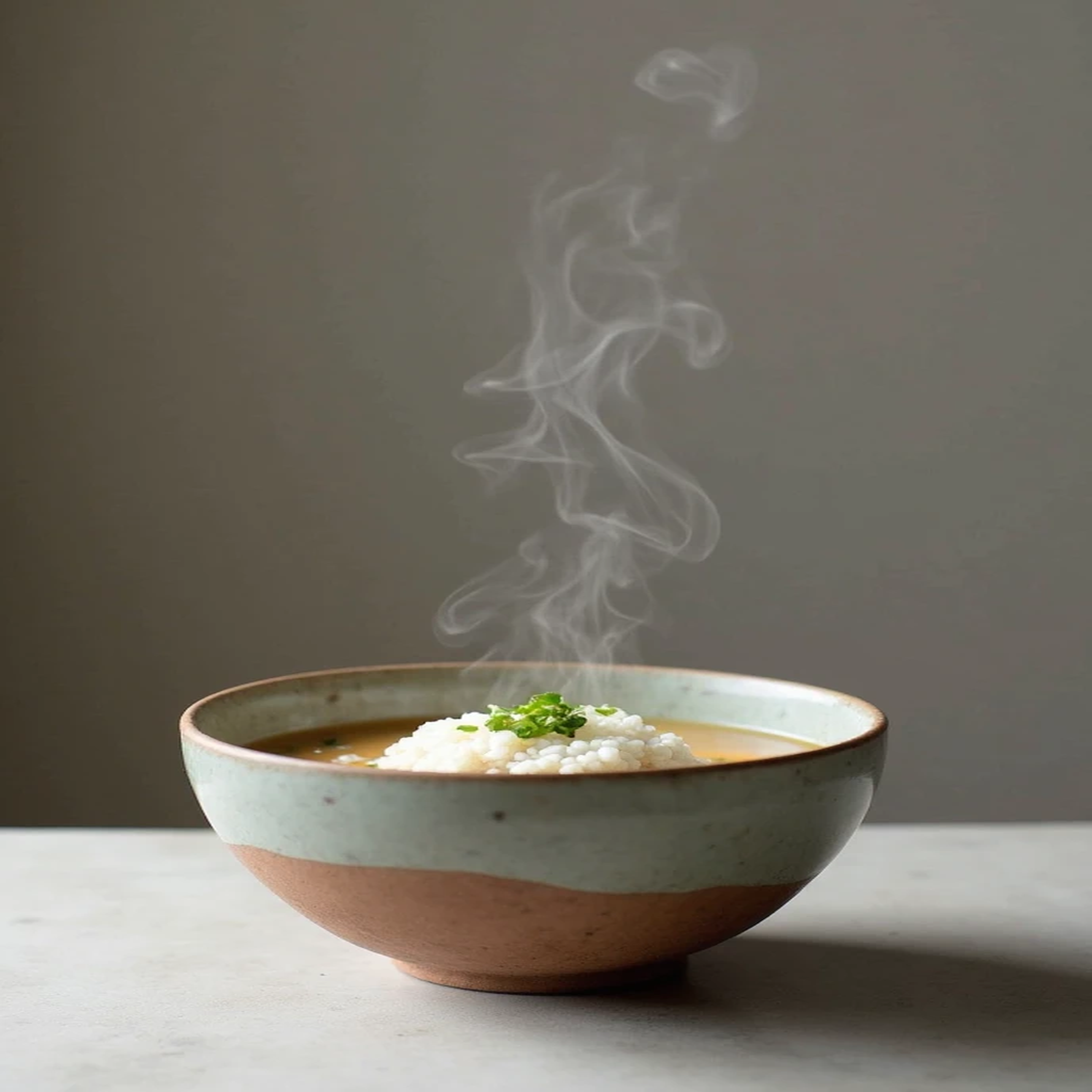
Congee is rice porridge. Sounds a little bland at first, but – A: it doesn’t have to be bland at all – there are some wonderfully delicious congee recipes out there. And B: there are also situations in which we actually want a simple, “boring” and bland congee.
Congee is made by cooking 1 part rice with 10 parts water until the rice breaks down and forms a soft porridge. It is very soothing for our inner mucous membranes – the gastrointestinal tract. In Chinese Medicine, we recommend congee as a nourishing food during and after gastrointestinal infections or food poisoning.
Outside of acute situations, congee can be prepared in creative and flavourful ways. Cooked in broth instead of water (bone broth, for example!), and enhanced with spices, vegetables, mushrooms and/or meat, it becomes a nourishing, easy-to-digest and comforting option for a warm breakfast, a light dinner or a snack in between meals. Sweet variations are possible, too. Congee can easily be prepared in advance and reheated later.
Basic Congee Recipe
You will need:
- 1 part white rice (e.g. 1 cup)
- 10 parts water (e.g. 10 cups)
How to prepare:
- Wash the rice until the water runs clear.
- Place the rice and water in a pot and ideally soak for at least 30 minutes, or overnight. (You can skip this step if you’re short on time.)
- Bring the rice to a boil, then simmer on low heat with the lid on for 1–3 hours.
- Stir occasionally.
- Congee is ready when it has turned into a creamy mush.
The type of rice you use will affect the texture and flavour. Jasmine rice (very aromatic), short-grain rice (like Sushi rice) and glutinous rice (which makes for a lovely creamy texture) work particularly well. You can also make congee with basmati rice. Feel free to mix different rice varieties, too. And if you have leftover rice from the day before, it can easily be turned into congee.
This basic recipe alone can serve as a simple, soothing home remedy for gastrointestinal problems. In Chinese Medicine, we say that the porridge gently coats and protects the inner mucous membranes, helping to soothe them. Adding a little soy sauce and honey gives it more flavour and provides some electrolytes.
(If you are experiencing significant fluid loss, be sure to seek medical advice. Children under 1 year of age must not be given honey.)
Congee can also be prepared as a comforting, nourishing option for mealtimes:
Congee Variations:
This is where you can get creative! Cook it in broth instead of water, add vegetables, mushrooms, meat, fish, spices… whatever your heart desires. Here are a few tips and some simple recipe ideas to get you started:
- The most nourishing version is to cook congee with Chinese bone broth. This combines the nourishing qualities of bone broth with the gentle, easy-to-digest nature of congee.
- Season it with homemade bone broth vegetable cubes.
- You can find my bone broth recipe here.
- Instead of water, you can also cook the rice in broth. Vegetable broth, chicken broth and other stocks are great for making savoury congee.
- Add vegetables from the beginning of the cooking process, towards the end if you’d like them to retain more of their texture, or as a topping once the congee is ready.
- Enhance the flavour with soy sauce, sesame oil, ginger, garlic or fresh herbs such as coriander or parsley.
- Wholegrain rice and other grains can also be used to make congee.
- Make sweet congee with fruit, berries and nuts.
Bone Broth Congee
A delicious congee made with the leftovers from beef bone broth. You’ll need:
- 1 cup white rice
- 5 cups water
- 5 cups beef bone broth
- The meat from your bone broth
- Garlic and onion
- Broccoli and mushrooms
Instructions:
- Wash the rice.
- Place the rice and water in a pot and let it soak for at least 30 minutes.
- Finely chop the garlic and onion and add them to the pot.
- Add the beef broth, bring everything to a boil, then simmer with the lid on for 1–3 hours.
- Once the congee has become creamy:
- Shred the beef into small pieces and add it.
- Cut the broccoli into small pieces and add them.
- Chop the mushrooms and add them.
- Simmer everything for another 5–10 minutes.
- Season with salt and pepper (and your homemade bone broth vegetable cubes).
And that’s it – your delicious bone broth congee is ready!
Of course, you can also make this recipe using chicken bone broth.
Congee with Chinese Cabbage and Shiitake
- Cook your basic congee with vegetable or chicken broth, garlic, ginger and the white parts of spring onions.
- Add dried shiitake mushrooms and cook them along with the rice.
- After about 30–45 minutes, remove the shiitake mushrooms.
- Towards the end of the cooking time, add the sliced shiitake mushrooms and Chinese cabbage cut into thin strips.
- Season with soy sauce and garnish with the green parts of the spring onions and toasted sesame oil.
Sweet Congee with Pear and Walnuts
- Prepare your basic congee with a pinch of salt.
- Chop ripe pears and dates and add them to the pot to cook.
- Towards the end of the cooking time, season with a little cinnamon, honey and a squeeze of lemon juice.
- Garnish with fresh pear and walnuts.
If you google ‘congee recipes’ you will find loads more delicious recipes. and variantion.
Enjoy! 😋